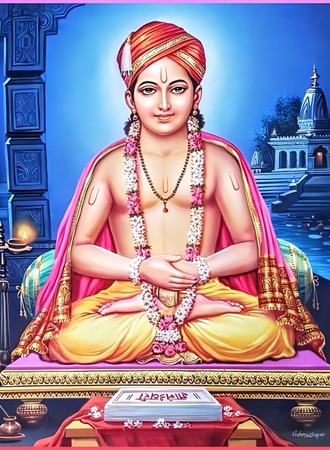
Sant Dnyaneshwar
Sant Dnyaneshwar
Sant Dnyaneshwar (1275–1296), also known as Dnyaneshwar Mauli was a revered 13th-century Marathi saint, poet, philosopher, and yogi from the Nath and Varkari traditions. In his brief life of just 21 years, he authored the Dnyaneshwari (a spiritual commentary on the Bhagavad Gita) and Amrutanubhav, both considered foundational texts in Marathi literature.
His teachings are rooted in Advaita Vedanta, blending non-dualism, yoga, and deep devotion (bhakti) to Lord Vithoba (a form of Vishnu). Sant Dnyaneshwar’s spiritual influence shaped the Varkari Bhakti movement and inspired saints like Eknath and Tukaram.
He took living samadhi in Alandi in 1296, where his shrine remains a major pilgrimage site.
Born – Dnyaneshwar 1275 Apegaon.
Died – 1296 (aged 20–21)
Resting place – Alandi, Yadava dynasty (present-day Khed Taluka, Pune District, Maharashtra, India)
Parents – Vithala Pant (father), Rukmini Bai (mother)
Honors – Sant (Saint), Dev (God) and Māulī (Mother)
Religion – Hinduism
Philosophy – Advaita, Varkari
Guru – Nivruttinath (elder brother)
Sant Dnyaneshwar was born in 1275 CE on Krishna Janmashtami in Apegaon village, near Paithan on the banks of the Godavari River, in a Marathi-speaking Deshastha Brahmin family. His birth occurred during the peaceful reign of Yadava King Ramadevarava, a known patron of arts and literature.
While some biographical details vary, records from disciples Satyamalanath and Sachchidanand confirm key events. The composition of his spiritual masterpiece, the Dnyaneshwari, is firmly dated to 1290 CE. Most accepted traditions agree he attained samadhi in 1296 at Alandi.
Life – Sant Dnyaneshwar, who lived only 21 years, is remembered for many miraculous events, such as making a buffalo recite the Vedas and riding a moving wall to humble a yogi—stories that reflect his divine stature.
His father, Vitthalpant, was the Kulkarni (village accountant) of Apegaon, Maharashtra. He was deeply spiritual and initially renounced family life to become a sannyasin in Kashi, seeking higher knowledge. Later, after a chance meeting between his guru Ramashrama and wife Rakhumabai, he was asked to return and resume family life in Alandi.
Vitthalpant and Rakhumabai had four children:
-
Nivruttinath (1273)
-
Dnyaneshwar (1275)
-
Sopan (1277)
-
Muktabai (1279)
Travel and demise – After writing Amrutanubhav, Sant Dnyaneshwar visited Pandharpur, where he met Sant Namdev, forming a deep spiritual friendship. Together, they traveled across India, spreading the Varkari tradition and composing devotional Abhangas. On their return to Pandharpur, they were honored in a feast attended by saints like Goroba, Sanvata, Chokhamela, and Parisa Bhagwat.
At the age of 21, Dnyaneshwar chose to take Sanjeevan Samadhi—a yogic practice of leaving the body through deep meditation. This event occurred on the 13th day of Kartik (Hindu calendar) at Alandi, where his Samadhi shrine now stands at the Siddheshwar Temple. According to tradition, Namdev’s prayer to Lord Vithoba brought Dnyaneshwar back momentarily, symbolizing the eternal bond of true friendship.
Many Varkaris believe that Dnyaneshwar still lives spiritually and blesses his devotees.
Sant Dnyaneshwar, a 13th-century saint and philosopher, was the first to write philosophical texts in Marathi, making complex spiritual knowledge accessible to common people. At just 16 years old, he composed the Dnyaneshwari (1290 CE), a profound commentary on the Bhagavad Gita, written in the Ovi metre, traditionally used in women’s folk songs. His companion Sacchidananda transcribed the work.
Dnyaneshwari ends with “Pasayadan”, a heartfelt universal prayer for the well-being of all humanity, reflecting Dnyaneshwar’s belief that “The whole world has one soul” (या विश्वाचा आत्मा एक आहे).
Choosing vernacular Marathi over classical Sanskrit, Dnyaneshwar revolutionized Indian literature and spirituality—similar to how Dante impacted Italian literature, as noted by scholar Bhagwat. His bold linguistic shift inspired the broader Bhakti movement and challenged the dominance of Sanskrit and upper-caste exclusivity.
He later authored Amrutanubhava, an independent philosophical text exploring deeper metaphysical ideas like Māyāvāda and Śūnyavāda. Scholars debate whether it was written before or after the Dnyaneshwari, but both works reflect Dnyaneshwar’s spiritual maturity.
During his pilgrimage to Pandharpur, he composed devotional Abhangas, becoming a key figure in the Varkari tradition.
In popular culture – Sant Dnyaneshwar’s life was depicted in the classic 1940 Marathi filmSant Dnyaneshwar, directed by Vishnupant Govind Damle and Sheikh Fattelal. Since 2021, the Marathi TV seriesDnyaneshwar Mauli has been airing on Sony Marathi, bringing his spiritual journey to modern audiences.
Works –
Undisputed authorship
- Dnyaneshwari or Bhavarthdipika (1290 CE)
- Amrutanubhava or Anubhavamrita (1292 CE)
- Changdev Pasashti (1294 CE)
- Haripath
- Abhangas
Works attributed to Dnyaneshwar –
- Commentary on Yoga Vasistha
- Pavana-Vijaya
- Pancikarana