Sant Rohidas
Sant Rohidas
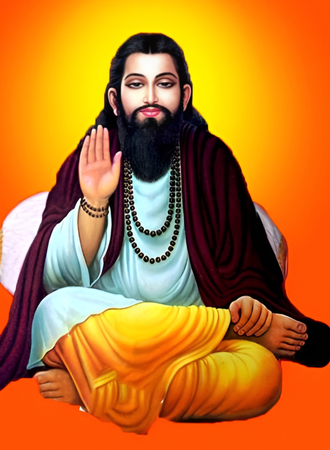
Ravidas, also known as Raidas, was a revered 15th–16th century Indian poet-saint, spiritual teacher, and social reformer of the Bhakti movement. Widely venerated across North and Central India, he preached against caste discrimination and promoted spiritual equality and unity. His devotional hymns, rich in messages of love and liberation, are featured in the Sikh Guru Granth Sahib and the Panch Vani of the Dadu Panthi tradition. Ravidas is also the central figure of the Ravidassia faith, continuing to inspire millions through his timeless teachings on devotion, equality, and inner freedom.
Name – Sant Rohidas
Born – Banaras, Delhi Sultanate in 1377 CE (present-day Varanasi, Uttar Pradesh, India)
Died –Banaras, Delhi Sultanate 1528 CE (present-day Varanasi, Uttar Pradesh, India)
Spouse – Lona Devi
Children – 1
Known for – Venerated as a Guru and having hymns included in the Guru Granth Sahib, central figure of the Ravidassia
Other names – Raidas, Rohidas, Ruhi Dass, Robidas, Bhagat Ravidas, Guru Ravidas
Occupation – Poet, leather craftsman, satguru (spiritual teacher)
Sant Ravidas, a revered 15th-century Bhakti saint, was born in Sir Gobardhanpur near Varanasi, Uttar Pradesh, into the Chamar community. His birthplace is now honored as Shri Guru Ravidass Janam Asthan, and his birth is celebrated annually as Ravidas Jayanti. Though he initially worked in leather crafting, Ravidas devoted his life to spiritual pursuits along the Ganges, often associating with sadhus and Sufi saints. A disciple of Ramananda and a contemporary of Kabir, Ravidas spread the message of equality, love, and devotion through his nirguna (formless God) philosophy. His poetic hymns and teachings transcended caste barriers, drawing followers from across India, with notable pilgrimage visits to Maharashtra, Gujarat, and the Himalayas. Today, Ravidas Temple stands as a major spiritual center celebrating his legacy.
The Adi Granth and the Panchvani of the Dadupanthi sect are the earliest known sources of Sant Ravidas’s literary works. The Adi Granth, the sacred scripture of Sikhism, includes 41 poems by Ravidas, making him one of its 36 key contributors. His verses address themes like social equality, justice, spiritual devotion, and the qualities of a true Yogi. Ravidas envisioned an ideal society free from discrimination and inequality. However, scholars like Jeffrey Ebbesen note that many later poems were wrongly attributed to him out of deep reverence, even though they may not reflect his original teachings.
Ravidas literature on symbolism – Peter Friedlander explains that the hagiographies of Sant Ravidas, though written centuries after his death, symbolically portray social and spiritual struggles in Indian society. These stories reflect conflicts between orthodox Brahminical traditions and emerging heterodox communities, highlight inter-religious tensions, and emphasize the soul’s journey toward spiritual awakening. While lacking historical evidence, these legends—such as Ravidas challenging Brahmins and Sultan Sikander Lodi—mirror the social dynamics of the 17th to 20th centuries. Miraculous tales like floating stones and reversing rivers symbolize divine triumph and deeper spiritual meaning.
Ravidas’s songs reflect both Nirguna and Saguna themes, blending core ideas of Nath Yoga philosophy in Hinduism. He often speaks of Sahaj, a mystical state of effortless unity between the one and the many—symbolizing spiritual oneness and inner harmony.
Raidas says, what shall I sing?
Singing, singing I am defeated.
How long shall I consider and proclaim:
absorb the self into the Self?
This experience is such,
that it defies all description.
I have met the Lord,
Who can cause me harm?
Hari in everything, everything in Hari –
For him who knows Hari and the sense of self,
no other testimony is needed:
the knower is absorbed.
Monistic Brahman or Anthropomorphic God– Several 18th and 19th-century manuscripts from Rajasthan and Uttar Pradesh document a philosophical debate between saints Kabir and Ravidas on the nature of Brahman (Ultimate Reality). Kabir advocates for a monistic, formless oneness, while Ravidas supports a divine, incarnate form. Though Ravidas eventually agrees with Kabir’s monistic view, Kabir firmly rejects the worship of any divine avatar, maintaining his stance against the sagun (with form) concept of God.
One man: two divergent claims on his views and philosophy–Ravindra Khare highlights that two distinct interpretations of Sant Ravidas’s philosophy emerge when analyzing historical texts. One perspective is rooted in the 17th-century Bhaktamal by Nabhadas, while the other is shaped by 20th-century Dalit literature. According to the Bhaktamal, Sant Ravidas was a spiritually enlightened figure known for his pure speech and the ability to resolve deep spiritual questions. He openly acknowledged his humble caste background without hesitation and engaged in philosophical discussions with people of all castes and genders, including Brahmins. The text also emphasizes that Ravidas’s teachings aligned with the Vedas and ancient scriptures, reflected a non-dualistic worldview, and demonstrated his attainment of the highest inner spiritual peace—a hallmark of true ascetic realization. This traditional account portrays Ravidas as a universally respected saint whose wisdom transcended social barriers.
Ravidassia– The difference between the Ravidassia and Sikhism, as described by a post made by Shri Guru Ravidass Temple in Ontario is as follows: The Ravidassia community follows distinct religious traditions and is separate from Sikhism, although it deeply respects the 10 Sikh Gurus and the Guru Granth Sahib for including Guru Ravidass Ji’s teachings. For Ravidassias, Guru Ravidass Ji is the supreme spiritual authority, and contemporary gurus who uphold his message of Naam, equality, and anti-caste values are also honored. The Ravidassia religion officially separated from Sikhism in 2010, after a tragic attack on a temple in Vienna. It now follows its own holy scripture, Amritbani Guru Ravidass Ji, which contains 240 hymns solely based on Guru Ravidass Ji’s teachings. The spiritual leadership is guided by Niranjan Dass of Dera Sachkhand Ballan.
Kathryn Lum summarises the dynamics behind the separation of Ravidassia and Sikhism, and its focus on Ravidas, as follows:
Ravidasias advocating for Chamar identity believe true progress lies in asserting their own distinct religious path. They view Sikhism as limiting the growth of the Chamar community as a separate quam (nation/religion), aligning instead with the Ad Dharm movement’s vision. For these separatist Ravidasias, spiritual and social advancement is rooted in exclusive devotion to Guru Ravidas. — Kathryn Lum, Sikhs in Europe
Places of worship – Sant Ravidas is a revered saint known for his spiritual wisdom and social reform. Honored by his devotees, he is seen as a powerful voice of religious protest rather than a symbol of cultural or spiritual unity. His teachings continue to inspire millions across generations.
Politics – A political party founded in India in 2012 by followers of Sant Ravidas promotes the vision of Begumpura—a “land without sorrow” symbolizing equality, peace, and a society free from suffering, as inspired by Ravidas’s teachings.
Guru Ravidas and Meera Bai –
There is a small chhatri (pavilion) in front of Meera’s temple in Chittorgarh district of Rajasthan which bears Ravidas’ engraved foot print.[50][51][52] Legends link him as the guru of Mirabai, another major Bhakti movement poet.[28][53]
Queen Mira Bai composed a song dedicated to Guru Ravidas where she mentioned him as her Guru.
Sadguru sant mile Ravidas
Mira devaki kare vandana aas
Jin chetan kahya dhann Bhagavan Ravidas
— “I got a guru in the form of sant Ravidas, there by obtaining life’s fulfillment.”
Art and Movie – Sant Ravidas Ki Amar Kahani