Sant Muktabai
Sant Muktabai
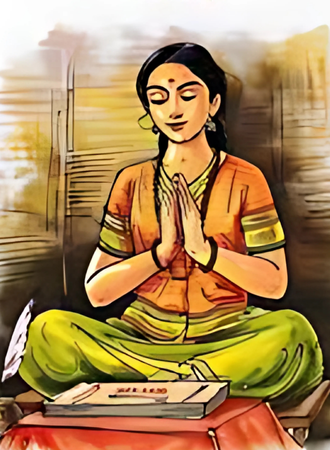
Muktabai or Mukta was a saint in the Varkari Movement. She was born in a Deshastha Brahmin family and was the younger sister of Dnyaneshwar, the first Varkari saint. She wrote forty-one abhangs throughout her life.
Name – Sant Muktabai
Born – 1279 Alandi
Died – 1297 Muktainagar
Honors – Sant in Marathi, meaning “Saint”
Religion – Hinduism
Order – Varkari tradition
Saint Muktabai, a revered figure in the Bhakti tradition, was born to Vitthalpant Kulkarni and Rukminibai Kulkarni. She had three elder brothers—Nivruttinath, Dnyaneshwar (Gyaneshwar Mauli), and Sopan—all of whom were saints and scholars deeply rooted in the Nath and Bhakti traditions.
Nivruttinath, the eldest, was initiated into the Nath sect by Guru Gahininath and guided his siblings on the spiritual path. He attained samadhi at Tryambakeshwar.
Dnyaneshwar (1275–1296) authored the Dnyaneshwari and Amrutanubhav, foundational texts in Marathi literature and Bhakti philosophy.
Sopan attained samadhi at Saswad near Pune and wrote Sopandevi, a Marathi commentary on the Bhagavad Gita, along with around 50 abhangs.
The siblings were known for their deep devotion and are famously depicted greeting Changdev while seated on a flying wall—symbolizing their spiritual greatness
According to Nath tradition, Muktabai was the youngest of four children born to Vitthal Govind Kulkarni and Rukmini, a devout couple from Apegaon near Paithan on the Godavari River. Vitthal, a Vedic scholar, married Rukmini in Alandi with the blessings of her father, Sidhopant.
Later, Vitthal sought sannyas in Kashi from Ramananda Swami, hiding his marital status. When the truth emerged, Ramananda sent him back, leading to the couple’s excommunication for violating sannyas dharma. Their children—Nivrutti (1273), Jñāneśvar (1275), Sopan (1277), and Muktabai (1279)—became key figures in the Bhakti and Nath traditions.
In hope of societal acceptance for their children, Vitthal and Rukmini are believed to have ended their lives at Prayag (Triveni Sangam), the sacred confluence of the Ganga, Yamuna, and Saraswati rivers.
- “Tatiche Abhang” (The Song of the Door) –
She says: “An ascetic is pure in mind and forgives the offences of people. If the world is hot as fire owing to exasperation, a sage should with pleasure be cool as water. If people hurt them with weapons of words, saints should treat those remarks as pieces of advice. This universe is a single piece of cloth woven with the one thread of Brahman, so please open the door, O Jnaneshwar.”
- Preachings to Changdev –
She says: “Though he has no form my eyes saw him, his glory is fire in my mind that knows his secret inner form invented by the soul. What is beyond the mind has no boundary. In it our senses end. Mukta says: Words cannot hold him yet in him all words are.” “Where darkness is gone I live, where I am happy. I am not troubled by coming and going, I am beyond all vision, above all spheres. His spirit lives in my soul. Mukta says: He is my heart’s only home
- In many places in Maharashtra, devotees worship Muktabai. In north Maharashtra people worship Muktai and do varis (devotional visits) to Muktai’s temple. Varkari consider saint Muktai ‘Adishakti’, Goddess. Varkaris sing abhangas written by Muktai. They call saint Muktabai – Muktai means mother Muktabai.
- A town’s name is changed from Edlabad to Muktainagar to honor saint Muktabai. This town is administrative center of Muktainagar taluka so the taluka also became Muktainagar taluka.
- Saint Muktai’s abhangas are included in Marathi text books of Balbharati in Maharashtra.
- Bhagwat Katha readers mention saint Muktai with great respect.