
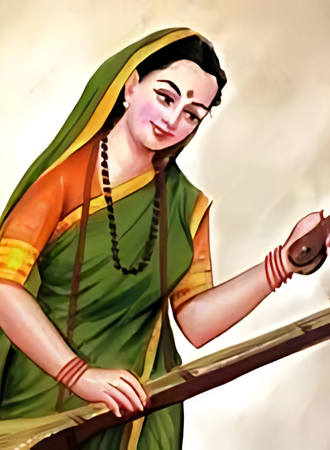
Sant Kanhopatra
Sant Kanhopatra
Kanhopatra was a 15th-century Marathi saint-poet revered by the Varkari sect of Hinduism. Once a courtesan and dancer, she renounced worldly life and surrendered herself to Lord Vithoba in Pandharpur, where she died in his temple—her samadhi uniquely lies within its sanctum.
Kanhopatra’s abhangas and ovis, rich in devotion, express her plea for spiritual liberation from her profession. Around 30 of her verses survive and are still sung by devotees. She is the only female Varkari saint to attain sainthood purely through devotion to Vithoba, without any guru or traditional lineage.
Name – Sant Kanhopatra
Born – 15th century (exact date unknown) Mangalvedha, Maharashtra, India
Died – 15th century (exact date unknown) Pandharpur, Maharashtra, India
Honors – Sant (संत) in Marathi, meaning “Saint”
Philosophy – Varkari
Religion – Hinduism
Sant Kanhopatra, a legendary Varkari saint, is known through oral traditions passed down over generations. Most stories agree she was born to Shama, a courtesan, and died at Vithoba’s temple in Pandharpur while escaping the Badshah of Bidar. While some versions mention Sadashiva Malagujar as her father and Hausa the maid, these characters don’t appear in all accounts. Her life symbolizes purity, devotion, and sacrifice
Early life – Kanhopatra, a saint-poet of the Varkari tradition, was born in Mangalvedha, near Pandharpur, to the courtesan Shama (or Shyama). Though raised in luxury, Kanhopatra’s social status was low due to her mother’s profession. Trained in music and dance, she became known for her beauty and talent, often compared to the celestial nymph Menaka.
Rejecting a life of wealth and royal favor, including her mother’s wishes to entertain the Badshah, Kanhopatra chose the path of devotion to Lord Vithoba. Denied marriage due to her birth, she instead dedicated herself completely to spiritual love, becoming a symbol of purity, resistance, and unwavering bhakti.
Path to devotion –Kanhopatra, a legendary Varkari saint and poet from Maharashtra, was born to courtesan Shama and is believed to be the daughter of Sadashiva Malagujar. Admired for her beauty and talent in dance and music, she refused to submit to Sadashiva’s demands, leading to harassment and financial decline for her family. Eventually, Kanhopatra fled to Pandharpur, disguised as a maid, with the help of her servant Hausa.
Inspired by Varkari pilgrims, she chose the path of bhakti (devotion) to Lord Vithoba, seeking spiritual acceptance over worldly praise. Despite her background, Kanhopatra’s devotion was unwavering. Her story symbolizes resistance, purity of devotion, and the breaking of social barriers in pursuit of divine love.
Death – During the same period, Kanhopatra, a devout Varkari saint and poet, refused the advances of Sadashiva, who then sought help from the Badshah of Bidar. Enchanted by her beauty, the king demanded she become his concubine. When Kanhopatra refused, the king’s soldiers surrounded the Vithoba temple in Pandharpur, threatening to destroy it.
Seeking refuge in the temple, Kanhopatra prayed to Lord Vithoba for one final meeting. According to tradition, she merged with the idol, fulfilling her spiritual longing. Some say she died at Vithoba’s feet, while others believe she attained siddhi (spiritual power) and vanished. Her samadhi (shrine) stands at the temple entrance, honoring her sacrifice and devotion.
Dating– The exact dates of Sant Kanhopatra’s life remain uncertain. Historians generally place her in the 15th century, with some suggesting she lived around 1428 CE or died around 1480. Other estimates range from 1448 to 1470, while rare accounts place her in the 13th or 16th century. Scholar Eleanor Zelliot notes she may have been a contemporary of Chokhamela and Namdev, linking her to the early Varkari tradition.
Kanhopatra, a Varkari saint-poet, is believed to have composed many abhangas, though only about thirty survive today. Her verses, featured in the Sakal Sant-Gatha, are mostly autobiographical and reflect deep emotional pain, social rejection, and spiritual longing.
Her poetry, marked by simplicity and clarity, highlights her struggle between her profession and devotion to Lord Vithoba. Kanhopatra often pleads for divine rescue from the shame and suffering tied to her social status. Her abhangas express a powerful cry for dignity and spiritual liberation, making her a symbol of female empowerment and devotion within the Varkari tradition. O Narayana, you call yourself
savior of the fallen…
My caste is impure
I lack loving faith
my nature and actions are vile.
Fallen Kanhopatra
offers herself to your feet,
a challenge
to your claims of mercy
Sant Kanhopatra, a revered Varkari saint, is honored in Mahipati’s Bhaktavijaya and Bhaktalilamrita for her unwavering devotion to Lord Vithoba. Born into a marginalized household without a guru or spiritual lineage, Kanhopatra is unique—attaining sainthood solely through pure bhakti.
Praised by saint Tukaram as an example of devotion transcending caste, her surrender to Vithoba is seen as a symbol of self-respect and spiritual strength. Her heartfelt abhangas like Aga Vaikunthichya Raya remain popular. Kanhopatra’s inspiring life has been portrayed in films and dramas, including the 1937 classic Kanhopatra and the 2014 short film Katha Sant Kanhopatra.